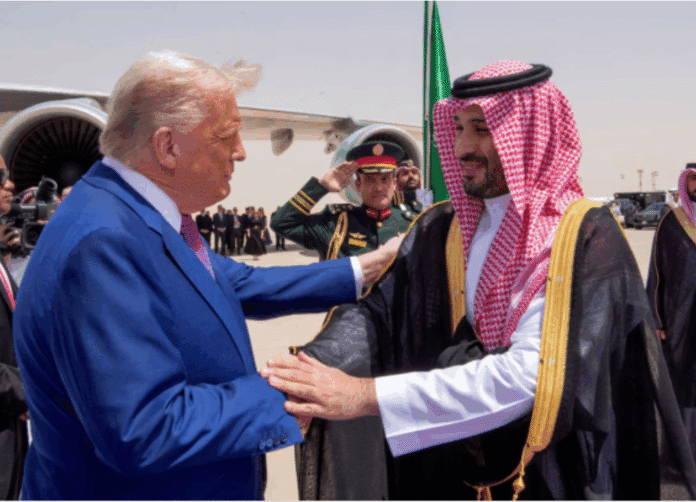
Saudi Arabia’s de facto ruler will visit the White House on Tuesday for talks with U.S. President Donald Trump, aiming to deepen long-standing cooperation on oil and security while expanding ties in commerce, technology, and potentially nuclear energy.
The trip marks Crown Prince Mohammed bin Salman’s first visit to the United States since the 2018 killing of Saudi journalist Jamal Khashoggi by Saudi agents in Istanbul a murder that triggered global outrage. U.S. intelligence concluded that the crown prince approved the operation. While Mohammed bin Salman denied ordering the killing, he acknowledged responsibility as the kingdom’s top decision-maker.
More than seven years later, both countries are seeking to turn the page. Trump hopes to advance a $600 billion Saudi investment pledge made during his 2017 visit to the kingdom. As in that earlier trip, he is expected to avoid raising human rights concerns.
The crown prince, meanwhile, is pushing for enhanced security guarantees amid rising regional instability, access to advanced artificial intelligence technologies, and movement toward a deal on a civilian nuclear program.
On Monday, Trump confirmed he plans to approve the sale of U.S.-made F-35 fighter jets to Saudi Arabia—an acquisition the kingdom has sought for years. “We will be doing that,” he told reporters.
Such a sale would represent a major policy shift, potentially reshaping the Middle East’s military balance and testing Washington’s longstanding pledge to maintain Israel’s “qualitative military edge.” Israel is currently the only country in the region operating the stealth aircraft.
“There is a page that has been turned” on the Khashoggi case, said Aziz Alghashian, a Saudi-based lecturer in international relations.
Defence at the Centre of Talks
The U.S.–Saudi partnership has long been anchored in an informal arrangement: Riyadh provides oil at stable prices, and Washington provides security. That understanding was shaken in 2019 when Iran attacked Saudi oil facilities and the United States did not respond militarily.
More recent regional turmoil including an Israeli strike in Doha in September has renewed Saudi concerns. After that incident, Trump issued a defence pact for Qatar through executive order, prompting speculation that Riyadh could receive something similar.
Saudi Arabia has sought a defence agreement ratified by the U.S. Congress, but Washington has tied such a pact to Saudi normalization with Israel. Riyadh has in turn conditioned normalization on Israel committing to Palestinian statehood something Israeli Prime Minister Benjamin Netanyahu vehemently opposes.
Analysts say an executive order, though falling short of a full treaty, could serve as an interim step. “It would be part of the process, not the end,” Alghashian said.
A Western diplomat summarized the negotiations: “Trump wants normalization, and Saudi wants a full defence pact, but the circumstances don’t allow it. In the end, both sides will likely get less than they want.”
Dennis Ross, a veteran Middle East negotiator, said such an executive order would require Washington and Riyadh to consult immediately in the event of a threat but would not obligate the U.S. to defend Saudi Arabia militarily. Assistance could range from providing replacement arms to deploying missile defense systems or naval forces.
Deals That Shape Regional Competition
Riyadh is also seeking agreements in nuclear energy and artificial intelligence as part of its Vision 2030 plan to diversify its economy and strengthen its geopolitical standing.
Access to high-end computer chips is central to the kingdom’s ambition to become a regional AI hub and compete with the UAE, which recently secured its own U.S. data-center deal.
Saudi Arabia is additionally pushing for a partnership with Washington on a civilian nuclear program, which would grant access to U.S. technology and bolster its position relative to Iran and the UAE. Negotiations have been slowed by U.S. demands that Riyadh forgo domestic enrichment and reprocessing capabilities that can be used to produce weapons-grade material.
Ross said he expects at least an announcement of progress on a nuclear agreement, if not a full deal.