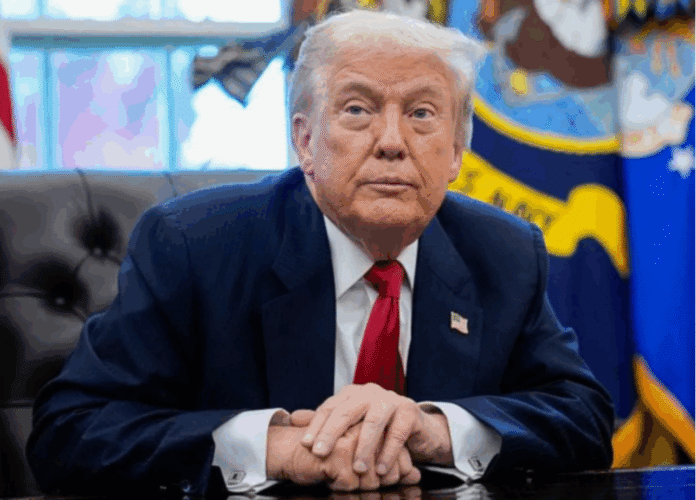
Donald Trump has warned Venezuela’s interim leader, Delcy Rodríguez, that she could “pay a very big price probably bigger than Maduro” if she fails to cooperate with the United States, escalating rhetoric following Washington’s dramatic military operation in Caracas.
The comments were made in an interview with The Atlantic, as Venezuela’s ousted president, Nicolás Maduro, prepared to appear in a New York court on Monday. Maduro faces U.S. charges including international drug trafficking and weapons offences accusations he has repeatedly denied.
The U.S. government claims Maduro presided over what it describes as a “narco-terrorist” regime. His arrest followed U.S. air strikes on Caracas on Saturday that resulted in Maduro and his wife, Cilia Flores, being captured and flown to the United States.
In the interview published Sunday, Trump said of Rodríguez: “If she doesn’t do what’s right, she is going to pay a very big price, probably bigger than Maduro.” He added that “regime change whatever you want to call it is better than what you have right now. It can’t get any worse.”
Trump also reiterated that the United States would “run” Venezuela temporarily until “a safe, proper and judicious transition” could be achieved. He said U.S. oil companies would be allowed to enter the country to repair infrastructure and generate revenue.
Despite those statements, Maduro’s political allies remain in control on the ground. Rodríguez, who was sworn in as interim president by Venezuela’s Supreme Court with the backing of the military, is scheduled to formally assume office in Caracas on Monday morning.
The Cuban government, a long-time ally of Maduro, said 32 Cuban “combatants” were killed during the U.S. operation and announced two days of national mourning.
U.S. Secretary of State Marco Rubio has insisted the United States is not at war with Venezuela, despite criticism from Democratic lawmakers who described the operation as an “act of war.” Speaking on multiple U.S. television networks, Rubio said the mission was a law-enforcement action targeting drug trafficking organisations, not the Venezuelan state.
“We are at war against drug trafficking organisations. That’s not a war against Venezuela,” Rubio told NBC’s Meet the Press. He added that Washington retains “multiple levers of leverage,” including restrictions on Venezuela’s oil sector, should the new leadership fail to comply with U.S. demands.
Rubio also defended the lack of congressional authorisation, saying prior notification would have risked leaks. He described Maduro’s arrest as having been carried out on the ground by FBI agents, rather than as a military invasion.
Trump further widened tensions by threatening neighbouring Colombia, saying he would not rule out military action and accusing Colombian President Gustavo Petro of enabling cocaine trafficking remarks that drew immediate concern from regional observers.
Maduro, who has ruled Venezuela since 2013, has long been accused by critics and foreign governments of repressing opposition and undermining democratic processes. He is widely viewed by opponents as having illegitimately won Venezuela’s 2024 election.
Venezuelan officials, however, have condemned the U.S. action as an illegal “kidnapping.” Defence Minister Vladimir Padrino said a “large part” of Maduro’s security detail, as well as soldiers and civilians, were killed during the operation — claims the U.S. has not independently confirmed.
Democratic leaders in the United States have strongly criticised the administration’s actions. House Minority Leader Hakeem Jeffries said the operation went far beyond a narcotics raid and amounted to a military intervention conducted without congressional approval. Senate Minority Leader Chuck Schumer questioned its legality, warning that past U.S.-led regime change efforts had come at great cost.
Both Jeffries and Schumer said they would support legislation blocking any further U.S. military action in Venezuela without authorisation from Congress.
International criticism has also mounted. In a joint statement, Brazil, Chile, Colombia, Mexico, Uruguay and Spain warned that the U.S. operation set a “dangerous precedent” for regional peace, endangered civilians, and violated principles of international law. The governments called for a peaceful resolution through dialogue and negotiation rather than external military intervention.