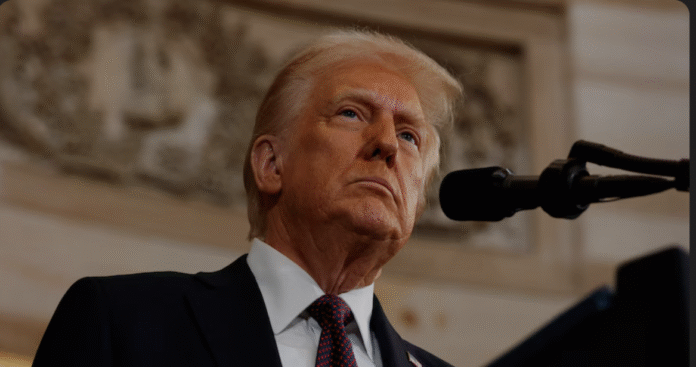
US President Donald Trump has issued a fresh warning to Nigeria, threatening action if the government “continues to allow the killing of Christians.”
In a video posted on Truth Social, Mr. Trump vowed to “do things to Nigeria that Nigeria is not going to be happy about” and to “go into that now-disgraced country guns-a-blazing.” His comments follow months of campaigning in Washington by politicians and advocacy groups alleging that Islamist militants are systematically targeting Christians in Nigeria.
However, a BBC investigation found that some of the data used to support these claims is difficult to verify.
In September, US television host Bill Maher described the situation as a “genocide,” saying that Boko Haram had “killed over 100,000 people since 2009 and burned 18,000 churches.” These figures, echoed widely on social media, have drawn strong reactions.
The Nigerian government has rejected the claims as “a gross misrepresentation of reality.” Officials in Abuja acknowledge that violence persists in the country but insist that “terrorists attack all who reject their murderous ideology — Muslims, Christians, and those of no faith alike.”
Independent researchers also say that most victims of jihadist violence in Nigeria are Muslims. Security analyst Christian Ani told the BBC that while Christians have indeed suffered attacks, there is no evidence that they are being deliberately targeted as a religious group.
Nigeria’s security crises are complex, involving multiple armed groups and regional factors. The country’s 220 million people are almost evenly split between Muslims and Christians, with most Muslims living in the north, where much of the violence occurs.
US Political Pressure
Texas Senator Ted Cruz has long campaigned on the issue. Citing similar statistics to Maher, he wrote on X that “since 2009, over 50,000 Christians in Nigeria have been massacred, and over 18,000 churches and 2,000 Christian schools destroyed.”
His office later clarified to the BBC that Cruz was not describing the situation as “genocide,” but as “persecution.” Still, he accused Nigerian officials of “ignoring and even facilitating the mass murder of Christians by Islamist jihadists.”
Echoing those words, Mr. Trump labelled Nigeria a “disgraced country,” alleging that its government “continues to allow the killing of Christians.”
Nigeria’s government denies the accusations, saying it is doing everything possible to combat jihadist groups. Some officials have welcomed US assistance provided it is done collaboratively, not unilaterally.
Origins of the Figures
Much of the data cited by US politicians appears to come from the International Society for Civil Liberties and Rule of Law (InterSociety), a Nigerian human rights NGO. In its August 2025 report, the group claimed that jihadist groups had killed more than 100,000 Christians since 2009, along with 60,000 “moderate Muslims.”
But InterSociety’s sources are opaque. The group acknowledges that it combines data from older reports with new “discoveries,” and it has not released itemized evidence to support its totals. The BBC found that many of the original reports it cited either lacked religious identifiers for the victims or contained duplicated incidents.
When BBC researchers added up the death tolls from the 70 media reports referenced by InterSociety for 2025, the total was closer to 3,000, not 7,000.
InterSociety responded that it includes “estimated” deaths in captivity and relies on local testimonies that it cannot make public.
Who Is Behind the Killings?
The group blames Islamist militants such as Boko Haram and Islamic State West Africa Province (ISWAP), as well as Fulani herders, whom it labels “jihadists.” This characterization has stirred controversy.
The Fulani, a mostly Muslim ethnic group found across West Africa, have often clashed with both Christian and Muslim farming communities over land and water. Analysts argue that these conflicts are primarily economic and ethnic, not religious.
“It’s a stretch to call them jihadists,” said analyst Christian Ani. “These are criminal and rogue elements, not religious warriors.”
Confidence McHarry of SBM Intelligence added that while the clashes can take on ethnic dimensions, they are often about territory and resources. “The more communities are displaced and worship centres attacked, the more it gets framed as a religious war,” he said.
InterSociety also lists “bandits,” mostly ethnic Fulanis in northwestern Nigeria, as perpetrators. These groups are involved in kidnapping and violence that affect both Christians and Muslims.
The Numbers Debate
Other data-tracking organisations, such as the Armed Conflict Location and Event Data Project (ACLED), report far lower figures. ACLED, whose data sources are fully traceable, estimates that around 53,000 civilians of all faiths have been killed in politically motivated violence since 2009. Between 2020 and September 2025, it recorded about 21,000 civilian deaths, with just 317 of those being specifically identified as Christian.
Trump’s Figures
In his Truth Social post last Friday, Mr. Trump cited 3,100 Christian deaths — a number drawn from Open Doors, a Christian organisation that monitors persecution worldwide. According to the group, 3,100 Christians and 2,320 Muslims were killed in Nigeria between October 2023 and October 2024.
Open Doors attributed nearly a third of the Christian deaths to “Fulani Terror Groups.” Senior research fellow Frans Veerman said, “Christians are still targeted, but increasingly, some Muslims are also victims of Fulani militants.”
Analysts note that attacks on mosques and Muslim communities are widespread across northern Nigeria. “This is part of the broader insecurity,” said McHarry. “These incidents are not seen as religious because the attackers and victims are often both Muslims.