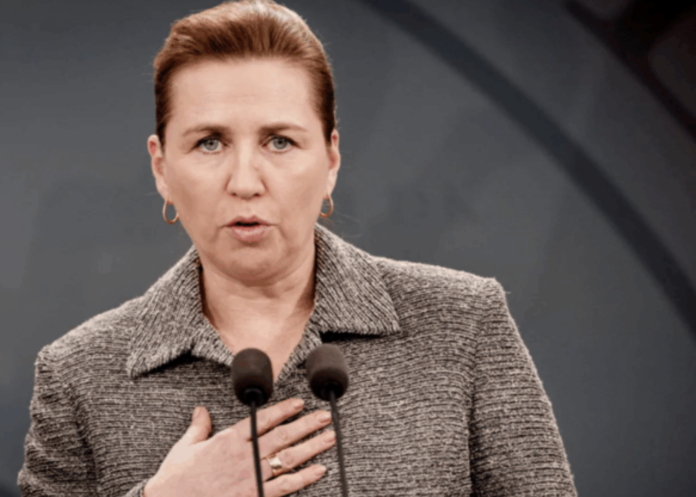
Denmark’s Prime Minister, Mette Frederiksen, has declared that “Europe will not be blackmailed” as European leaders consider how to respond to tariff threats from US President Donald Trump linked to his proposal to take control of Greenland.
Trump has warned that he will impose new tariffs in February on eight US allies Denmark, Finland, France, Germany, the Netherlands, Norway, Sweden and the UK if they oppose his plan to acquire the autonomous Danish territory. He has argued that Greenland is vital to US national security and has not ruled out the use of force, remarks that have drawn widespread criticism.
In response, the affected countries issued a joint statement warning that Trump’s proposal risked triggering a “dangerous downward spiral” in transatlantic relations. “Tariff threats undermine transatlantic relations,” the statement said, adding that the countries “stand in full solidarity with the Kingdom of Denmark and the people of Greenland”.
The statement also reaffirmed the countries’ commitment to strengthening Arctic security as Nato allies and stressed their readiness to engage in dialogue based on respect for sovereignty and territorial integrity.
Writing on Facebook, Frederiksen said Denmark was open to cooperation but would not yield to pressure. “We want to cooperate and we are not the ones seeking conflict,” she wrote. “Europe will not be blackmailed. It is more important than ever that we stand firm on the fundamental values that created the European community.”
UK Prime Minister Sir Keir Starmer said he had spoken with Frederiksen, European Commission President Ursula von der Leyen and Nato Secretary-General Mark Rutte before holding a call with Trump. A spokesperson for Downing Street said Starmer emphasised that Greenland’s security was a shared Nato concern and warned that imposing tariffs on allies for pursuing collective security was wrong.
Trump has threatened to introduce a 10% tariff on goods from the eight countries from 1 February, with the possibility of raising it to 25% if no agreement is reached. He accused the countries of playing a “very dangerous game” and claimed the situation posed a threat to global security.
Greenland, though sparsely populated, is strategically significant due to its location between North America and the Arctic, offering advantages for missile early-warning systems and regional surveillance. US Treasury Secretary Scott Bessent said Greenland could only be properly defended as part of the United States, adding that he believed Europeans would eventually accept Trump’s position.
Norwegian Foreign Minister Espen Barth Eide told BBC Newshour that respect for sovereignty and territorial integrity was a “non-negotiable” principle of international law and cooperation.
French President Emmanuel Macron said the EU could activate its “anti-coercion instrument” if the tariffs are imposed, as he works to coordinate a European response. Trump, Macron, German leaders and EU officials are all expected to attend the World Economic Forum in Davos this week.
Canadian Prime Minister Mark Carney also expressed concern over rising tensions, announcing increased investment in Arctic security and stressing that Nato cooperation remained the best approach.
Meanwhile, protests against Trump’s Greenland proposal continued in Denmark and Greenland over the weekend, including demonstrations in Nuuk and Copenhagen. The protests coincided with a visit by a US Congressional delegation, whose leader, Senator Chris Coons, described Trump’s rhetoric as “not constructive”.
Greenland’s representative to the US said that a January 2025 survey showed only 6% of Greenlanders supported joining the United States, with 85% opposed. A recent Reuters/Ipsos poll similarly found that most Americans oppose the idea, with just 17% in favour of US control of Greenland.