
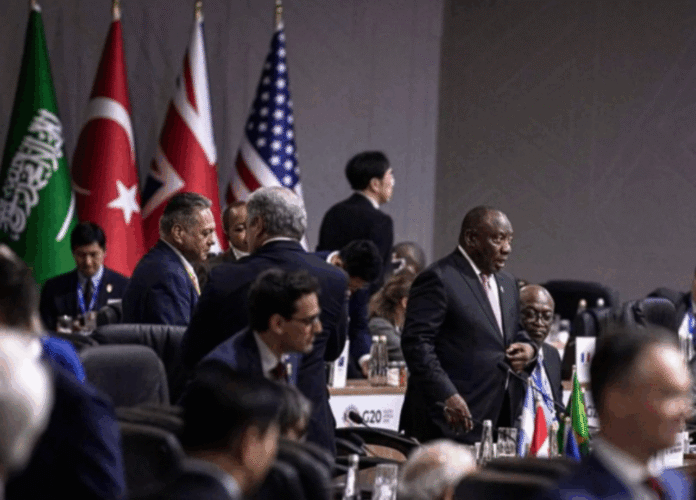
The G20 summit in South Africa marking the first time the gathering of major global economies has been hosted on the continent ended with a joint declaration affirming a commitment to “multilateral co-operation.”
The declaration, which addressed climate change mitigation and global economic inequality, was adopted despite objections from the United States, which boycotted the meeting in Johannesburg.
Speaking at the closing ceremony on Sunday, South African President Cyril Ramaphosa said the agreement demonstrated that “shared goals” outweighed political differences among member states.
US President Donald Trump opted not to attend the summit, citing a widely debunked claim that South Africa’s white minority faces widespread killings and land dispossession.
Indonesia, India, and Brazil have led the G20 over the past three years. The United States will assume the G20 presidency in 2026, with the summit expected to be held at Trump’s golf course in Florida.
The ceremonial handover of the presidency, scheduled for Sunday, did not take place and is now expected to occur next week, led by junior officials.
Brazilian President Luiz Inácio Lula da Silva downplayed Trump’s absence, saying it “didn’t matter much,” and insisted that multilateralism is “more alive than ever.”
German Chancellor Fredriech Merz described the US decision to abstain as unwise. He told Reuters that the G20 discussions underscored that “the world is currently undergoing a realignment, and new connections are being formed.”
Delegates also reached consensus on working toward “just, comprehensive, and lasting peace” in Ukraine, Sudan, the Democratic Republic of Congo, and the “Occupied Palestinian Territory.”
Sudanese journalist and commentator Saeed Abdalla noted the significance of Sudan’s inclusion in the declaration.
“I think for the first time, the G20 has brought the Sudan conflict to the forefront after more than two years,” he told local broadcaster Newzroom Afrika.