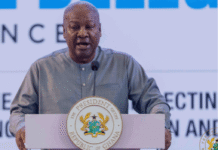

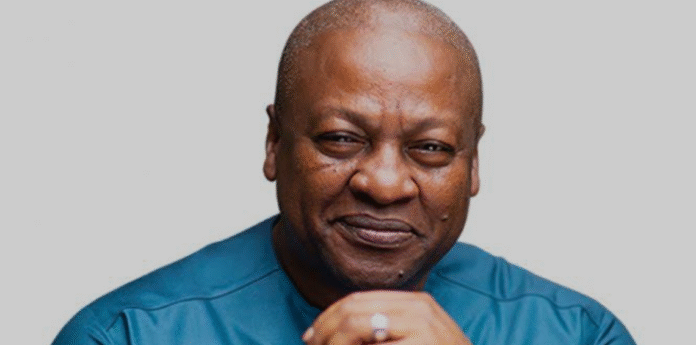
President John Dramani Mahama has re launched the National Sanitation Day initiative, which will now be observed by all 261 Metropolitan, Municipal, and District Assemblies (MMDAs) on the first Saturday of every month, beginning in October.
The initiative, originally introduced in 2014 during his first administration, forms part of government’s efforts to promote cleanliness and improve environmental health nationwide.
At the re-launch ceremony in Madina, near Accra, President Mahama explained that the renewed programme will strengthen local government structures by making sanitation a Key Performance Indicator (KPI) for all Metropolitan, Municipal, and District Chief Executives (MMDCEs). It will also encourage citizen participation and accountability in maintaining clean surroundings.
Beyond monthly clean up exercises, the President stressed the importance of instilling cleanliness in the younger generation. He revealed ongoing discussions with the Ministry of Education to introduce a curriculum on courtesy and responsible citizenship from the basic to secondary school level.
“If we train our children properly from the start, when they grow, they will not depart from it,” he said.
Empowering Chiefs in Sanitation Enforcement
President Mahama also suggested amending Chapter 22 of the 1992 Constitution to empower chiefs to establish sanitation courts to deal with persistent polluters.
“Our chiefs were once at the forefront of voluntarism, communal labour, and cleanliness. Unfortunately, their authority has diminished over time. I am in favour of restoring some of that power, especially in relation to sanitation and the environment,” he said.
He proposed that such sanitation courts could operate within chiefs’ palaces in collaboration with district assemblies, ensuring offenders are sanctioned appropriately.
“This will not take away the responsibilities of the district administrations but rather complement them,” the President added.
Financing Sanitation Efforts
Touching on resources, President Mahama noted that during his tenure, he directed that 80% of the District Assemblies’ Common Fund be disbursed directly to the MMDAs to eliminate excuses of inadequate funding.
“MMDCEs have the resources, and sanitation will be one of the key KPIs by which your performance will be measured. The best-performing district and traditional area will also be rewarded,” he stated.
Support from Stakeholders
Mr. Ahmed Ibrahim, Minister of Local Government, Chieftaincy and Religious Affairs, said the re launch aims to reignite a national movement for cleanliness, discipline, and dignity.
“Environmental sanitation has long posed a formidable challenge in Ghana. Improper waste disposal, poor drainage management, indiscriminate littering, and weak enforcement of bylaws have led to outbreaks of cholera, malaria, and typhoid, as well as flooding, damage to infrastructure, and economic setbacks,” he said.
He described the initiative as a “bold declaration” that Ghana will no longer tolerate environmental pollution and its consequences.
Ogyeahohuo Yaw Gyebi II, President of the National House of Chiefs, who chaired the event, pledged the full support of the House for the programme, emphasising its importance in building cleaner, healthier communities.