
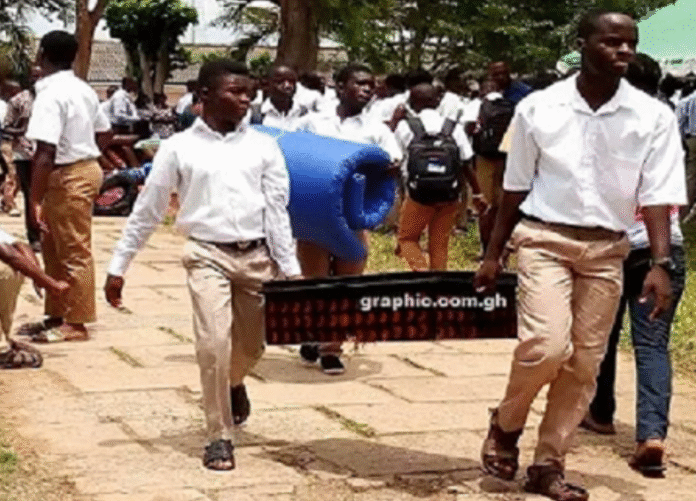
Private Senior High Schools (SHSs) across Ghana are preparing to welcome their first batch of students under the government’s pilot Free SHS expansion programme.
Beginning Monday, October 21, about 25,000 students are expected to report to 70 accredited private schools nationwide. The initiative aims to ease congestion in public SHSs and phase out the controversial double-track system introduced to manage overcrowding.
According to the Ministry of Education, enrolment in public SHSs has surged from 432,000 in 2016 to over 1.3 million in 2023 since the Free SHS policy was launched in 2017. This sharp increase stretched infrastructure and forced the introduction of the double-track calendar, which divided students into alternating groups with shortened academic terms.
The new pilot seeks to address these challenges by involving private schools in the national Free SHS framework.
Private Schools “Ready and Equipped”
Speaking on Channel One Newsroom on Friday, October 17, Naphtali Kyei-Baffour, spokesperson for the Conference of Heads of Private Second Cycle Schools (CHOPSS), said private schools were fully prepared to receive the new students.
“Yes, indeed, we are expecting quite a number of students to report to the SHSs — that is, the 70 schools participating in the pilot. We are expecting to receive almost 25,000 of them,” he stated.
He added that some students had already begun visiting their new schools for orientation and prospectuses ahead of reopening.
“Some of them have started coming for their prospectus and are ready to join just as they have been posted. We are ready — in terms of facilities, preparedness, and everything, we are ready to receive them,” he assured.
Pilot Details and Funding
Launched in September 2024, the pilot is a partnership between the Ministry of Education, the Ghana National Council of Private Schools (GNACOPS), and CHOPSS.
According to GNACOPS Executive Director, Obenfo Nana Kwasi Gyetuah, the 70 participating schools are spread across all 16 regions and have a combined capacity to accommodate up to 44,000 students, leaving room for future expansion.
The government will provide each day student with an annual grant of GH₵994 (approximately $70) to cover tuition and basic academic needs. This arrangement, formalized through a Memorandum of Understanding between the Ministry and CHOPSS, ensures parity with funding levels in public schools.
Parents opting for boarding arrangements will pay the difference between the government subsidy and the full boarding cost.
Education Minister Haruna Iddrisu described the pilot as “a vital part of the government’s commitment to equitable access to quality education,” noting that the inclusion of private schools helps leverage existing infrastructure, improve standards, and strengthen public-private partnerships in the education sector.
Sector Reactions and Future Prospects
The inclusion of private schools has received widespread approval from education stakeholders. CHOPSS President I.K. Mensah commended the initiative as a “progressive step,” adding that ongoing discussions with the Ministry could lead to further expansion and possible adjustments in funding.
Education experts also believe Ghana’s approach could serve as a model for other African countries struggling with overcrowded schools.
According to UNESCO, sub-Saharan Africa is facing the fastest-growing demand for secondary education globally, with an estimated 90 million additional students expected by 2030.
The 25,000 students set to begin classes this week represent about 6% of all 2024 SHS admissions. Officials say that if the pilot proves successful, it could be scaled up significantly, supporting Ghana’s progress toward achieving Sustainable Development Goal 4, universal access to secondary education by 2030.
A Boost for Private Education
For many private SHSs, the programme offers a much-needed revival. Several schools have operated below capacity in recent years due to economic constraints.
GNACOPS estimates that over 2,000 private second-cycle institutions are registered nationwide, with a combined capacity to absorb more than 200,000 students.
As government-sponsored students begin reporting to classrooms on Monday, educators and parents alike will be watching closely to see whether this landmark public-private collaboration can transform Ghana’s secondary education landscape.