
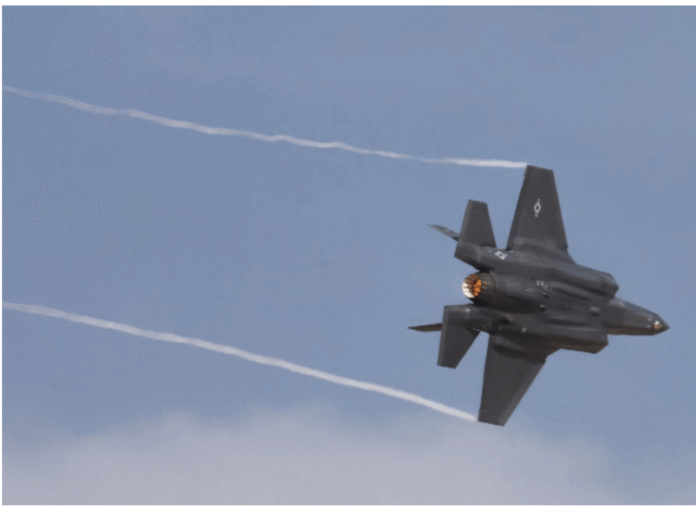
President Donald Trump announced on Monday that he plans to approve the sale of U.S.-made F-35 fighter jets to Saudi Arabia, just a day before hosting Saudi Crown Prince Mohammed bin Salman for high-level talks.
“I will say that we will be doing that,” Trump told reporters in the Oval Office. “We’ll be selling the F-35s.”
If finalized, the sale would represent a major policy shift with potential implications for the Middle East’s military balance and for Washington’s longstanding commitment to preserving Israel’s “qualitative military edge.” Saudi Arabia has requested up to 48 F-35s in a multibillion-dollar deal that recently cleared a key Pentagon review, Reuters reported earlier this month.
The kingdom has pursued Lockheed Martin’s advanced fighter for years. A senior White House official said before Trump’s remarks that the president intended to discuss the jets with the crown prince “before making a final determination.”
A Renewed Push
Saudi Arabia, already the largest buyer of U.S. weapons, sees the F-35 as crucial to modernising its air force and countering regional threats, especially from Iran. Its military currently operates a mix of Boeing F-15s, European Tornados, and Typhoons.
Riyadh made a direct appeal to Trump earlier this year to secure the jets. U.S. officials told Reuters that the Pentagon’s policy arm has been working on the potential deal for months.
Under U.S. law, weapons sales in the Middle East are assessed to ensure Israel maintains a superior technological advantage. Israel has operated the F-35 for nearly a decade and remains the only country in the region equipped with the stealth aircraft.
Diplomatic and Political Hurdles
The F-35 issue has also intersected with broader diplomatic negotiations. The Biden administration previously considered supplying the jets to Saudi Arabia as part of a larger agreement that included the possibility of Riyadh normalising relations with Israel, though those talks collapsed.
Any final sale could still face resistance in Congress. Lawmakers have scrutinized U.S. arms deals with Saudi Arabia since the 2018 killing of journalist Jamal Khashoggi, and some remain cautious about deepening military cooperation with the kingdom.