
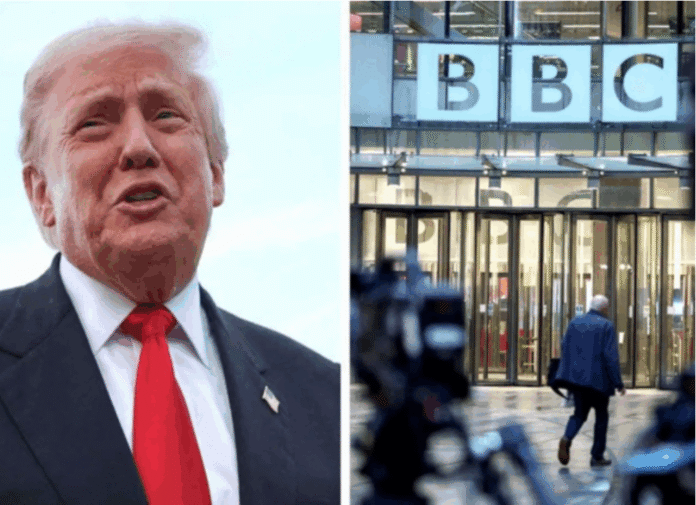
US President Donald Trump has launched a multi-billion-dollar defamation lawsuit against the BBC, accusing the broadcaster of misleadingly editing his 6 January 2021 speech in a Panorama documentary.
Court documents filed in Florida allege that the BBC defamed Trump and violated a trade practices law. He is seeking $5 billion (£3.7bn) in damages for each claim. Trump’s legal team argues that the broadcaster “intentionally, maliciously, and deceptively doctored” his speech.
The BBC has previously apologised to Trump for the edit, acknowledging that it created “the mistaken impression” that he had made a direct call for violent action. However, the corporation has rejected his demand for compensation and maintains there is no legal basis for a defamation claim. The BBC has not yet formally responded to the lawsuit.
Trump first signalled his intention to sue last month, after the documentary aired in the UK ahead of the 2024 US presidential election. “I think I have to do it,” he told reporters. “They cheated. They changed the words coming out of my mouth.”
In the original speech delivered shortly before the US Capitol riot, Trump said: “We’re going to walk down to the Capitol, and we’re going to cheer on our brave senators and congressmen and women.” Nearly an hour later, he added: “And we fight. We fight like hell.”
The Panorama programme edited these remarks together to make it appear as though Trump said: “We’re going to walk down to the Capitol… and I’ll be there with you. And we fight. We fight like hell.”
In November, a leaked internal BBC memo criticised the editing of the speech. The controversy later led to the resignation of the BBC’s director general, Tim Davie, and the head of news, Deborah Turness.
Prior to the lawsuit, BBC lawyers argued there was no malice involved and said the programme caused Trump no harm, noting that he was re-elected shortly after it aired. They also stated that the BBC neither owned the rights to nor distributed the documentary in the United States. While the programme was available on BBC iPlayer, access was limited to UK viewers.
In his lawsuit, Trump disputes this, citing alleged licensing agreements between the BBC and third-party distributors that may have allowed the documentary to be shown outside the UK. He also claims that viewers in Florida could have accessed the programme using VPN services or via the streaming platform BritBox.
The lawsuit further argues that increased VPN usage in Florida following the documentary’s release makes it highly likely that residents of the state viewed the programme before it was removed.
The BBC has not commented on the alleged distribution agreements or the claims relating to VPN and streaming access.