

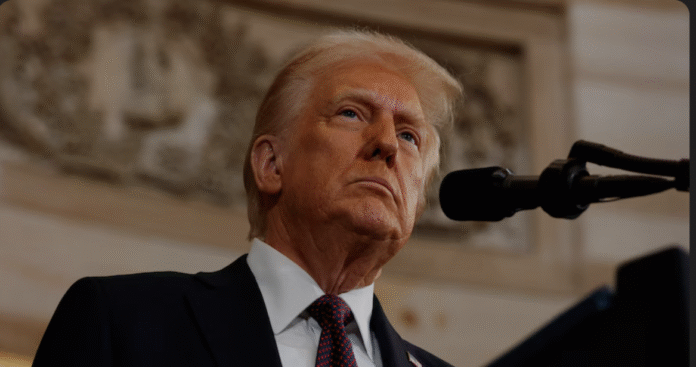
U.S. President Donald Trump announced on Tuesday that his administration will begin pursuing the death penalty in homicide cases committed in Washington, D.C.
“If somebody kills someone in the capital, Washington, D.C., we’re going to be seeking the death penalty, and that’s a very strong deterrent,” Trump said during a White House cabinet meeting. “I don’t know if this country is fully ready for it, but we have it and we have no choice.”
The move marks another step in Trump’s campaign to position himself as a law-and-order president while exerting greater federal control over the nation’s capital, a city where residents largely lean Democratic.
Trump has already declared an emergency in Washington, deployed hundreds of National Guard troops, and sent federal law enforcement to support local police, claiming violent street crime has reached unacceptable levels. Local officials, however, dispute this, citing federal and city data showing crime has fallen since its 2023 peak. Trump has also warned that similar measures could be extended to other cities, including Chicago.
Washington, D.C., holds a unique status as a federal district under congressional authority rather than state governance. While Congress passed the Home Rule Act in 1973 granting residents the right to elect a mayor and city council, Trump has threatened to override local control to combat crime and homelessness.
Although Washington has abolished the death penalty for local offenses, it remains applicable under federal law. The U.S. Attorney’s Office in Washington, which handles both local and federal cases, has been encouraged by the Trump administration to pursue federal charges as part of its crackdown.
Attorney General Pam Bondi in February ended a Biden-era moratorium on most federal executions. The Justice Department has already announced plans to seek the death penalty in the case of Luigi Mangione, accused of fatally shooting UnitedHealth executive Brian Thompson last year.
If applied broadly, the policy would significantly increase the number of defendants facing federal death sentences. However, such prosecutions are typically lengthy, as defendants have multiple avenues for appeal, meaning cases can take years before resolution.