
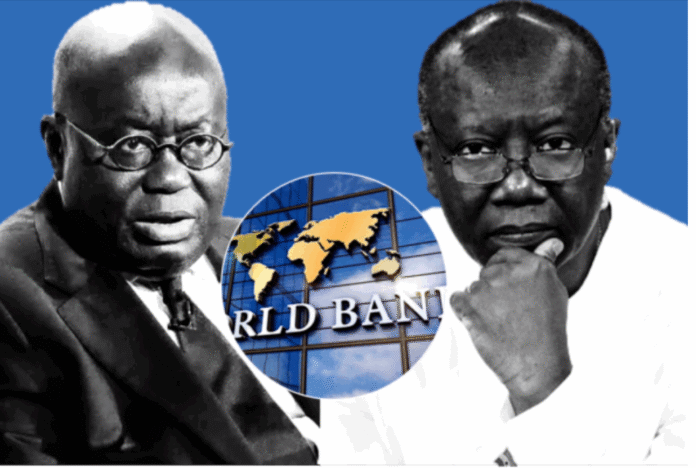
The World Bank has rejected the Akufo-Addo administration’s long-held assertion that Ghana’s 2022 economic meltdown was primarily driven by global shocks, insisting instead that the crisis was largely self-inflicted.
In its 2025 Policy Notes on Ghana, the Bank stated bluntly:
“The deterioration of global conditions due to the COVID-19 pandemic and the Russian Federation’s invasion of Ukraine was not the cause of the 2022 macroeconomic crisis; rather, it merely exposed an economy already beset with deep structural vulnerabilities and precarious macroeconomic conditions.”
For years, government officials have blamed the severe downturn marked by runaway inflation, a collapsing cedi, and a sovereign debt default on external factors. The World Bank’s analysis, however, points squarely to domestic policy failures.
The report cites weak governance, fiscal indiscipline, and delayed reforms, arguing that easy access to international capital markets and over optimistic expectations about natural resource revenues fostered political short-termism, eroded accountability, and weakened the social contract.
It highlights a familiar cycle of fiscal expansion followed by painful austerity, a pattern that has driven Ghana into 17 separate IMF programmes over the past 68 years.
“Sudden macroeconomic stops and crises have led the country to request a record number of IMF programs, remaining under active IMF support for 40 out of its 68 years of history,” the Bank noted.
The human toll has been severe. The World Bank estimates that the 2022 crisis and its aftermath pushed more than 800,000 Ghanaians into poverty, with income per capita stagnating at about US $2,200 for a decade and poverty now affecting over a quarter of the population.
The Bank also sounded the alarm over renewed fiscal excesses ahead of the 2024 election, citing unbudgeted spending commitments of roughly US $4.8 billion about 5.7% of GDP much of it outside official public-finance systems.
“Spending indiscipline poses a critical challenge to Ghana’s macro-fiscal stability… the absence of stringent expenditure controls frequently results in budget overruns and excessive borrowing, undermining efforts to maintain fiscal discipline and compromising long-term sustainability,” it warned.
Beyond fiscal lapses, chronic inefficiencies in key sectors continue to weigh heavily on the economy. The energy sector alone costs around 2% of GDP each year, with arrears mounting despite repeated reforms. Meanwhile, COCOBOD’s debt ballooned to US $1.8 billion by 2024, with its interventions distorting farmer incentives and weakening overall industry performance.
The World Bank stresses that Ghana stands at a critical crossroads and that quick fixes will no longer suffice:
“There is an urgent need to signal a clear break from the past and a commitment to change… Success will ultimately be measured by the government’s ability to regain the trust of its citizens.”
Its prescriptions are clear and uncompromising: restore fiscal discipline, broaden the tax base, reform state-owned enterprises, and strengthen governance.
Without decisive action, the Bank warns, Ghana risks remaining trapped in the cycle of crisis and bailout that has defined much of its post-independence economic history.